
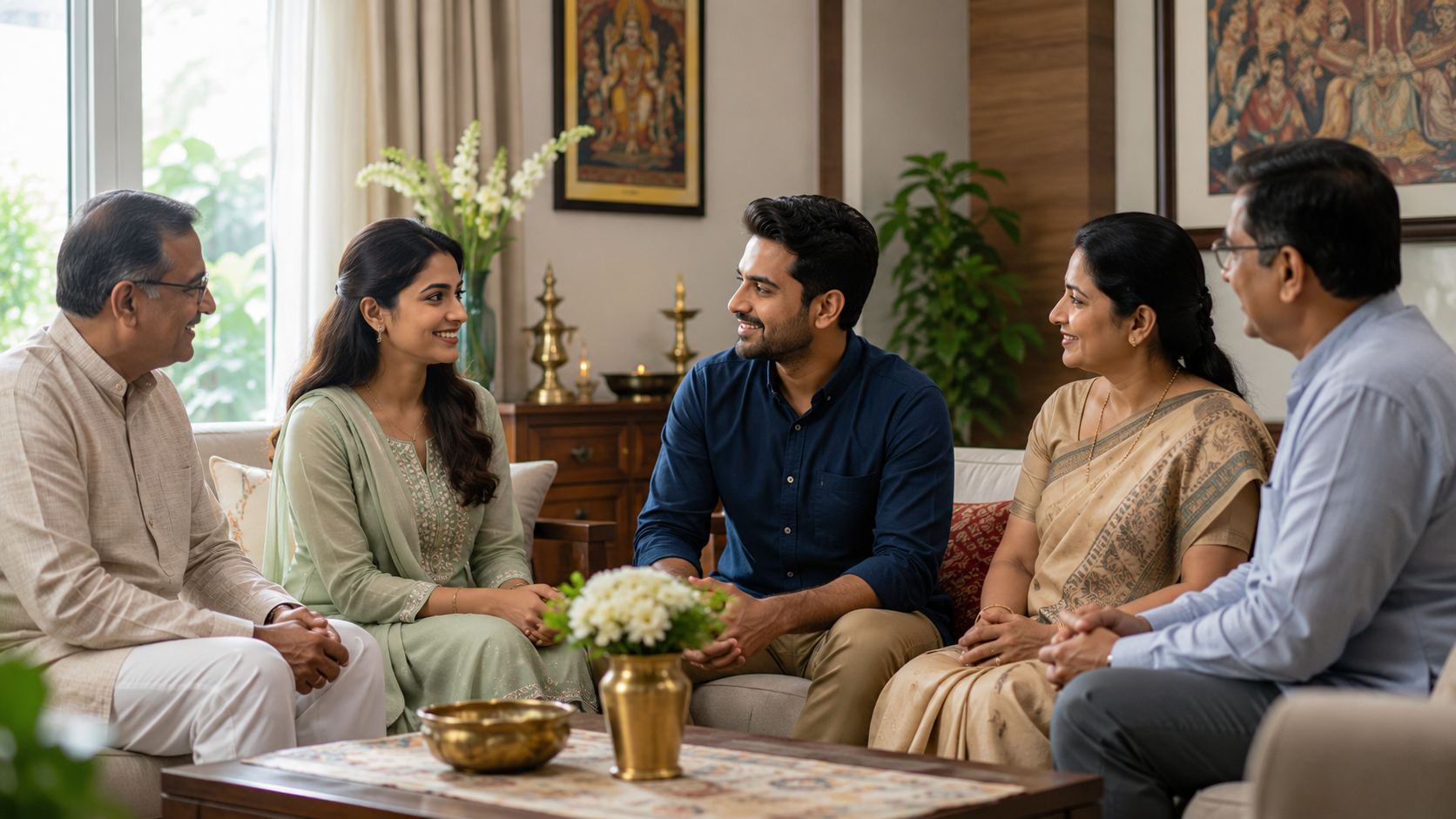
Marriage Compatibility in Hindu Matrimony: What Families Should Look For Beyond Education and Career
In Hindu matrimony, families often begin the search with practical filters: education, profession, location, age, family background, language, community, and cultural expectations.
These factors matter. They help families identify profiles that may be suitable on paper.
But a suitable profile is not the same as a compatible marriage.
Marriage compatibility goes deeper than résumé strength or family reputation. A lasting marriage depends on values, communication, emotional maturity, lifestyle alignment, family expectations, adaptability, and mutual respect.
For Sri Vaishnava and broader Hindu families, this balance is especially important. Many families want to preserve tradition while also respecting the individuality, career goals, and modern realities of the bride and groom. Many candidates live in the United States, India, Canada, the United Kingdom, Australia, or other parts of the world, which makes compatibility even more layered.
The purpose of this guide is to help families evaluate compatibility thoughtfully — without turning marriage into a checklist.
Why Compatibility Matters More Than a Perfect Profile
A profile can look excellent on paper and still not be the right match.
A person may have a strong education, respected career, good family background, and suitable community match. But if two people cannot communicate well, do not respect each other’s life goals, or have very different expectations about family involvement, location, lifestyle, or married life, the match may become difficult later.
At the same time, a profile that is not “perfect” on every filter may still lead to a meaningful marriage if the core values align. Learn how to create a perfect profile.
Compatibility is not about finding someone identical. It is about finding someone with whom a stable, respectful, and happy life can be built.
The strongest matches usually combine:
Shared values
Emotional maturity
Respectful communication
Practical alignment
Family compatibility
Flexibility
Mutual commitment
Families should still use practical criteria, but they should avoid stopping there.

1. Values Compatibility
Values are the foundation of marriage.
In Hindu matrimony, families often talk about “good values,” but it is important to be specific. Values may include:
Respect for family
Honesty
Responsibility
Kindness
Humility
Spiritual or cultural connection
Financial discipline
Commitment to marriage
Respect for elders
Willingness to support each other
Two people do not need to agree on every small issue, but they should share a similar moral and emotional foundation.
Questions to Consider
Does this person value family relationships?
Do they show respect in how they speak?
Are they honest about their expectations?
Do they seem responsible and emotionally steady?
Do they understand marriage as a partnership?
For Sri Vaishnava families, values may also include respect for sampradayam, temple traditions, vegetarian lifestyle preferences, and dharmic living. These should be discussed with warmth and clarity, not pressure.
2. Communication Compatibility
Communication is one of the strongest predictors of long-term harmony.
During the matrimony process, observe how the bride, groom, and families communicate.
Do they respond respectfully? Do they listen? Do they ask thoughtful questions? Do they avoid judgmental language? Are they clear without being harsh?
Good communication does not mean constant agreement. It means both people can speak honestly and respectfully.
Healthy Communication Signals
Responds with sincerity
Listens without interrupting
Asks mature questions
Handles disagreement calmly
Does not avoid important topics
Speaks respectfully about family
Does not pressure or rush unnecessarily
Warning Signs
Dismissive tone
Delayed or careless communication without explanation
Excessive demands early in the process
Avoiding practical questions completely
Speaking disrespectfully about parents or prior conversations
Treating the process like a transaction
A person’s communication style during the match process often reveals how they may communicate in marriage.
3. Family Compatibility
In Hindu marriage, family compatibility matters. The couple may build their own life, but the relationship between families often shapes the emotional environment around the marriage.
Family compatibility does not require both families to be identical. One family may be more traditional, another more modern. One may be based in India, another in the United States. One may be more temple-oriented, another more culturally connected but less ritual-focused.
The key question is whether both families can respect each other.
What to Evaluate
Do the families communicate with dignity?
Are expectations stated respectfully?
Is there flexibility on customs and logistics?
Are both sides willing to understand each other?
Is there respect for the bride and groom’s preferences?
Are sensitive topics handled with maturity?
When families approach the process with humility and mutual respect, differences become easier to navigate.
4. Lifestyle Compatibility
Lifestyle compatibility affects daily married life.
It includes ordinary but important questions:
Food habits
Religious or spiritual practice
Social life
Financial habits
Travel interests
Work-life balance
Daily routine
Health and wellness
Friend circles
Expectations around festivals and family gatherings
For example, if one person strongly prefers a vegetarian household and the other does not, that should be discussed. If one person expects frequent temple participation and the other is less involved, that should be understood early. If one person prefers a quiet family-centered lifestyle while the other wants a highly social life, that may require adjustment.
The goal is not to judge. The goal is to understand whether daily life will feel harmonious.
5. Career and Ambition Compatibility
Education and career are important, but compatibility is not only about how impressive the job title is.
Families should consider how both people view career, ambition, stability, relocation, work hours, and long-term goals.
Important Questions
Is each person supportive of the other’s career?
Are both comfortable with demanding work schedules?
Is relocation possible or difficult?
Does one person expect the other to prioritize family over career?
Are both aligned on financial responsibility?
How do they view future career growth?
For NRI families, career and location often become closely connected. A bride may be building a career in New York while a groom is settled in California. A groom may be working in the United States while the bride is in India. A candidate may be open to relocation but only if career opportunities are reasonable.
These are practical realities. They should be discussed respectfully before the process goes too far.
6. Location and Relocation Compatibility
Location can become one of the most important practical issues in modern matrimony.
Families should clarify whether the bride or groom is open to relocating, and under what conditions.
Questions to Discuss
Is the person open to moving within the same country?
Are they open to moving internationally?
Would they prefer to stay close to parents?
Are there visa or immigration considerations?
Is remote work possible?
How important is proximity to temple, community, or Indian family networks?
Are both people aligned on long-term settlement plans?
Location flexibility should not be assumed. A profile may look compatible, but if both people are firmly tied to different cities or countries, the match may become difficult.
The best approach is to discuss location early, but not abruptly.
7. Emotional Maturity
Emotional maturity is often more important than external accomplishments.
A person who is emotionally mature can handle disagreement, communicate clearly, respect boundaries, take responsibility, and show patience during uncertainty.
Signs of Emotional Maturity
Speaks respectfully
Does not blame quickly
Can discuss difficult topics calmly
Shows empathy
Understands family responsibilities
Has realistic expectations
Does not treat marriage as only personal convenience
Can balance individual goals and shared responsibilities
Marriage requires adjustment from both people. Emotional maturity helps couples navigate that adjustment with grace.
Families should pay attention not only to what is said, but how it is said.

8. Spiritual and Cultural Compatibility
For many Hindu families, cultural and spiritual compatibility matters deeply.
This may include:
Respect for Hindu traditions
Participation in festivals
Temple visits
Vegetarian or sattvic food preferences
Respect for elders
Language and cultural continuity
Interest in raising future children with cultural grounding
Understanding of community customs
For Sri Vaishnava families, this may also include connection to sampradayam, Divya Desam traditions, acharya parampara, temple practices, and reverence for Lord Vishnu and Sri Mahalakshmi.
Not every person will practice in the same way. Some may be deeply devotional. Others may be culturally connected but less ritual-focused. Compatibility depends on whether both people respect each other’s level of practice and can build a shared household with mutual understanding.
Avoid using spirituality as a test to judge someone harshly. Use it as a way to understand alignment.
9. Financial Attitude Compatibility
Money is not the first topic families usually want to discuss, but financial attitude matters in marriage.
This does not mean asking about salary aggressively. It means understanding responsibility, stability, planning, and expectations.
Families and candidates should eventually understand:
Spending habits
Saving habits
Debt obligations
Career stability
Financial goals
Expectations around supporting parents
Approach to joint planning
Lifestyle expectations
Financial compatibility is not about one person being wealthy. It is about whether both people can make responsible decisions together.
These discussions should happen with maturity and timing. Early conversations should not feel intrusive, but serious matches should eventually discuss practical financial expectations.
10. Readiness for Marriage
Not every person with a matrimony profile is equally ready for marriage.
Some are serious and prepared. Others are exploring because parents asked them to. Some may not yet have clarity on location, career, timing, or expectations.
Families should gently evaluate readiness.
Signs of Readiness
Actively participates in the process
Communicates respectfully and consistently
Has thought about marriage expectations
Is open to serious conversations
Understands practical responsibilities
Can balance personal preferences with family context
Is not avoiding every next step
If the bride or groom is not involved, does not respond, or seems uninterested, the family should pause and understand why.
A successful match requires genuine participation from both individuals.
What Families Should Discuss Before Moving Forward
Once initial interest exists, families and candidates should gradually discuss important topics.
Early-Stage Topics
Basic family background
Education and career
Current location
Broad partner expectations
Cultural and community alignment
Whether both sides are interested in continuing
Mid-Stage Topics
Relocation possibilities
Career priorities
Family involvement
Lifestyle preferences
Spiritual or cultural practices
Communication expectations
Timeline for next steps
Later-Stage Topics
Financial planning
Long-term settlement
Children and parenting expectations
Support for parents
Wedding expectations
Detailed family responsibilities
Not every topic belongs in the first conversation. Good judgment matters.
Compatibility Questions for Brides and Grooms
These questions can help the bride and groom understand each other better.
What does a good marriage mean to you?
How do you like to communicate when there is disagreement?
How important is family involvement in your married life?
Are you open to relocation? Under what conditions?
How do you balance career and family life?
What traditions or cultural practices are important to you?
How do you view financial planning and responsibility?
What kind of lifestyle do you hope to build after marriage?
How do you like to spend weekends and holidays?
What qualities do you value most in a spouse?
These questions should be asked naturally, not like an interview.
Compatibility Questions for Parents
Parents can also evaluate compatibility thoughtfully.
Does the other family communicate respectfully?
Are expectations realistic?
Is the bride or groom actively involved?
Are both families aligned on broad values?
Is there flexibility where needed?
Are practical concerns being handled maturely?
Does the match seem emotionally comfortable for the children?
Are both sides showing sincerity?
Is there pressure or unnecessary urgency?
Does this feel like a family we can build a respectful relationship with?
Parents should use these questions to guide reflection, not to create excessive scrutiny.
Common Compatibility Mistakes
Mistake 1: Overvaluing Education and Career Alone
A strong degree or job does not guarantee emotional maturity or shared values.
Mistake 2: Ignoring Communication Style
If communication feels disrespectful or inconsistent early, pay attention.
Mistake 3: Avoiding Location Questions
Location and relocation can become major issues later. Discuss them respectfully.
Mistake 4: Assuming Family Values Are the Same
Even within the same community, families may have different expectations.
Mistake 5: Treating Preferences as Demands
Compatibility requires flexibility. A demand-heavy process can push away good matches.
Mistake 6: Rushing Because the Profile Looks Good
A strong profile is a good start, not a final decision.
Mistake 7: Ignoring the Bride or Groom’s Comfort
The individuals must feel comfortable moving forward. Family enthusiasm alone is not enough.
A good match is not only about matching profiles. It is about matching lives.
Education, career, community, and family background are important, but lasting compatibility depends on values, communication, maturity, lifestyle, and mutual respect.
Find Matches Based on Values, Trust, and Compatibility
Marriage compatibility is built on more than surface-level filters. A meaningful match should bring together family values, emotional maturity, communication, cultural understanding, practical alignment, and genuine willingness to build a shared life.
SVMatrimony helps Sri Vaishnava and Hindu families connect in a respectful, family-centered environment where trust and compatibility matter.
Create a complete profile, share your values clearly, and approach each conversation with sincerity and openness.
FAQ Section
What does marriage compatibility mean in Hindu matrimony?
Marriage compatibility in Hindu matrimony means alignment across values, family expectations, communication, lifestyle, culture, career goals, location preferences, emotional maturity, and readiness for marriage. It goes beyond education, profession, and community background.
Is education enough to determine compatibility?
No. Education and career are important, but they do not guarantee compatibility. Families should also evaluate values, communication style, emotional maturity, lifestyle expectations, and long-term goals.
How important is family compatibility in Hindu marriage?
Family compatibility is important because Hindu marriage often brings two families together. The families do not need to be identical, but they should communicate respectfully and understand each other’s expectations.
What compatibility questions should brides and grooms ask?
Brides and grooms can ask about marriage expectations, communication style, family involvement, relocation, career goals, cultural practices, financial responsibility, and lifestyle preferences. These questions should be asked naturally and respectfully.
How can parents evaluate compatibility without pressuring their children?
Parents can guide the process by asking thoughtful questions, observing communication, understanding family values, and supporting their child’s comfort level. They should avoid forcing decisions based only on profile strength or family preference.
Why is location compatibility important for NRI families?
Location matters because many NRI families are spread across countries and cities. Relocation, visa considerations, career plans, and proximity to family or community can affect married life and should be discussed respectfully.
How do Sri Vaishnava families evaluate compatibility?
Sri Vaishnava families may consider education, family background, values, sampradayam, cultural practices, vegetarian lifestyle preferences, spiritual orientation, communication, location, and readiness for marriage. The best approach is respectful and balanced.