
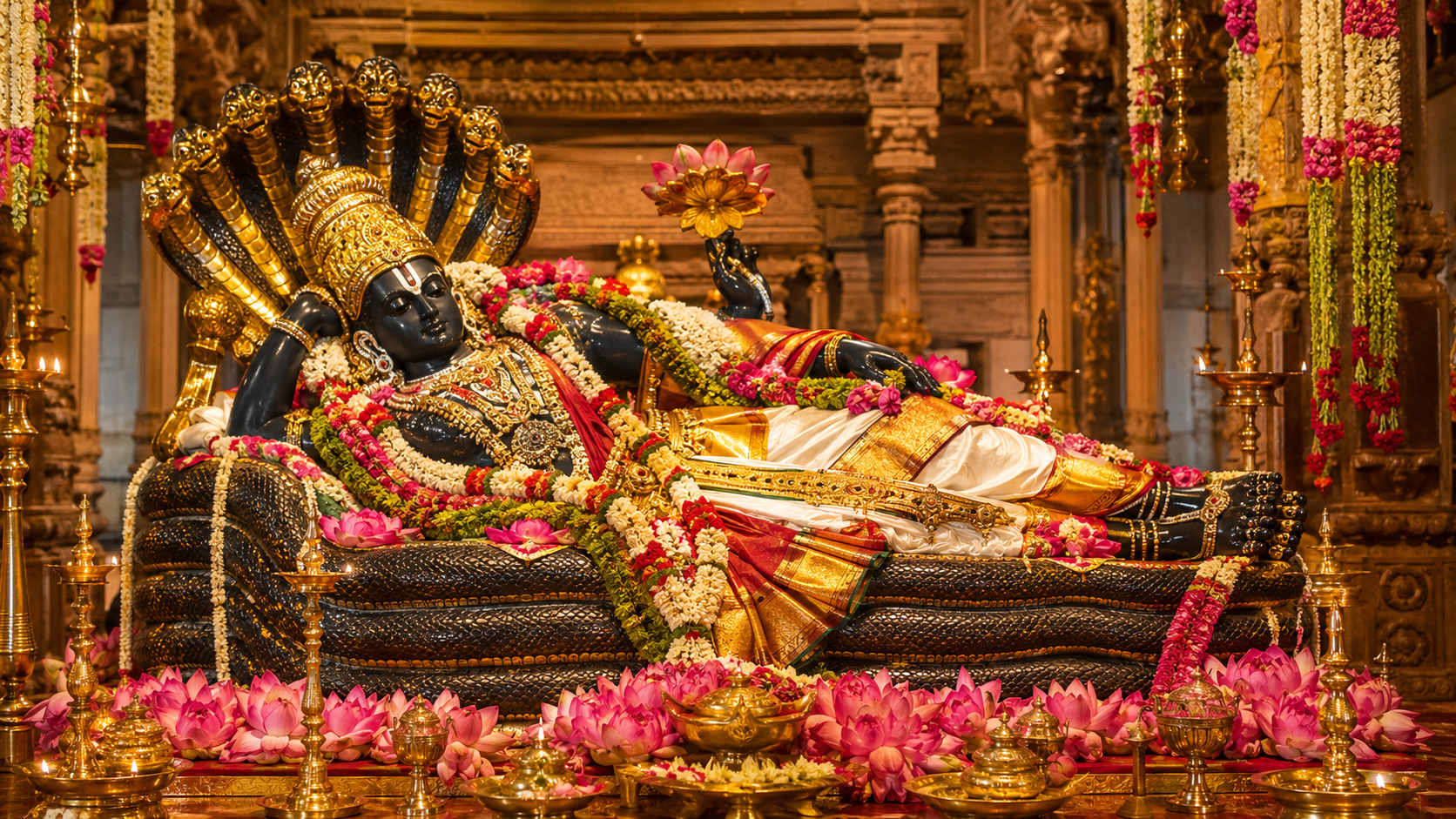
Sriman Narayana Thirunakshatram: Periya Perumal and Avani Rohini
Among Sri Vaishnava sacred observances, Sriman Narayana Thirunakshatram holds a uniquely profound place.
It is not merely another date in the festival calendar. It points to the very center of Sri Vaishnava life: Sriman Narayana, inseparable from Sri Mahalakshmi, the supreme refuge, the source of grace, and the first principle of the sampradayam.
In many Sri Vaishnava calendar references, Sriman Narayanan, also revered as Periya Perumal, is associated with Avani Rohini. Periya Perumal is especially beloved in the Srirangam tradition as Sri Ranganatha, the reclining Lord of Bhuloka Vaikuntam, the foremost Divya Desam, and the beginning point of the Oran Vazhi Guru Parampara.
For families, this observance is an opportunity to remember not only Perumal’s divine majesty, but also his accessibility, compassion, and intimate connection to family life, temple culture, acharya lineage, and daily devotion.
For Sri Vaishnava families living across India, the United States, Canada, the United Kingdom, Australia, Singapore, the Middle East, and beyond, Avani Rohini can become a beautiful family observance: a day to teach children who Periya Perumal is, why Srirangam matters, how Sri Vaishnava tradition begins with the Divya Dampati, and how a home becomes sacred when Perumal is remembered with love.
Editorial Accuracy Note
Sri Vaishnava calendars and local temple traditions may differ in how they list and observe certain sacred days.
Some traditional monthwise references list Sriman Narayanan / Periya Perumal under Avani Rohini. Some also include Periya Perumal under Panguni Rohini in specific calendar contexts. Families should follow their own acharya, mutt, temple, or family panchangam for exact observance details.
This article focuses on Avani Rohini as a Sri Vaishnava devotional observance connected to Sriman Narayana / Periya Perumal, while respectfully acknowledging that temple-specific practice may vary.
Who Is Periya Perumal?
Periya Perumal generally refers to Sri Ranganatha of Srirangam, the reclining form of Sriman Narayana at the great Sri Ranganathaswamy Temple.
The name itself carries reverence. “Periya” means great, elder, or supreme in devotional usage. “Perumal” refers to the Lord. In the Sri Vaishnava heart, Periya Perumal is not merely one form among many. He is the Lord of Srirangam, the one worshipped by Azhwars, Acharyas, and countless generations of devotees.
Sri Ranganatha reclines on Adisesha, facing south, blessing all beings with grace. He is seen not only as a temple deity but as the compassionate Lord who receives the surrender of devotees.
In Sri Vaishnava understanding, Srirangam is often called Bhuloka Vaikuntam — Vaikuntam on earth. The temple is not just an architectural marvel. It is a spiritual universe, a living center of Divya Prabandham, acharya tradition, utsavams, kainkaryam, and community life.
Why Srirangam Matters in Sri Vaishnava Tradition
Srirangam is regarded as the foremost among the 108 Divya Desams. It is sung by Azhwars and revered by Acharyas. It is the place where temple worship, Divya Prabandham, Sri Vaishnava philosophy, and acharya lineage converge powerfully.
For Sri Vaishnavas, Srirangam is not only a pilgrimage destination. It is a spiritual homeland.
It is associated with:
Periya Perumal, Sri Ranganatha
Periya Piratti, Sri Ranganayaki Thayar
Namperumal, the processional deity
Ramanuja and the Sri Vaishnava acharya tradition
Divya Prabandham recitation
Araiyar Sevai
Vaikunta Ekadashi
Panguni Uthiram Serthi Sevai
Adhyayana Utsavam
Daily temple kainkaryam
When families observe Sriman Narayana Thirunakshatram, Srirangam naturally becomes part of the reflection because Periya Perumal represents the living center of Sri Vaishnava devotion.

The Story of Sri Ranganatha: From Divine Worship to Srirangam
One of the most beloved traditions connected to Periya Perumal is the story of how Sri Ranganatha came to Srirangam.
According to the Srirangam sthala tradition, the Ranga Vimanam and Sri Ranganatha were worshipped by Brahma. The deity later came into the Ikshvaku lineage and was worshipped by Sri Rama. After the victory over Ravana, Sri Rama gave Sri Ranganatha to Vibhishana, Ravana’s righteous brother, who wished to take the Lord to Lanka.
As Vibhishana journeyed south, he reached the banks of the Kaveri. There, Sri Ranganatha chose to remain at Srirangam. In compassion for Vibhishana, the Lord is said to face south, blessing him and all devotees.
This story is powerful for families because it teaches several Sri Vaishnava values:
Bhagavan chooses where he wishes to bless devotees.
The Lord’s grace is not limited by geography.
A devotee’s longing is never ignored.
Srirangam is a place of divine residence, not merely temple construction.
Perumal’s compassion extends even across distance.
For diaspora families, this story carries a special meaning. Even when families live far from India, Perumal’s grace is not far. A home altar, a lamp, a pasuram, a child learning a story, and a family remembering Perumal together can all become forms of connection.
Sriman Narayana as the First Refuge
Sri Vaishnavism begins and ends with surrender to Sriman Narayana, inseparably united with Sri Mahalakshmi.
The term Sriman Narayana itself carries the theology of the Divya Dampati: Narayana is always with Sri. The Lord is never understood apart from Thayar’s compassion. In Sri Vaishnava life, surrender is not a cold philosophical act. It is a relationship of dependence, grace, and refuge.
Periya Perumal, as Sri Ranganatha, embodies this accessible refuge.
He reclines, but his grace is active. He appears restful, but his compassion is awake. He is supreme, yet approachable. He is the Lord of the universe, yet he receives the simplest offering of a family with affection.
That is why Avani Rohini can be observed not merely as a calendar day, but as a day of returning to the foundation:
Sriman Narayana is our refuge. Periya Perumal is the Lord of our home, our sampradayam, and our family life.
Avani Rohini: Why This Day Feels Special
Avani is a Tamil month that usually falls around August–September. Rohini is the nakshatra traditionally associated with beauty, nourishment, and divine affection in many Vaishnava contexts.
Avani Rohini is also widely recognized in Hindu and Vaishnava communities because of Sri Jayanthi / Krishna Jayanthi observances in many traditions. In Sri Vaishnava calendar listings, Avani Rohini also appears with Sriman Narayanan / Periya Perumal, which gives the day a broader Vaishnava resonance.
For families, Avani Rohini can be approached with two complementary devotional moods:
Kannan anubhavam — remembering Krishna’s sweetness, playfulness, and divine accessibility.
Periya Perumal anubhavam — remembering Sriman Narayana as Sri Ranganatha, the reclining Lord of Srirangam and first refuge of the sampradayam.
This allows families to teach children that Perumal is both majestic and intimate, cosmic and personal, supreme and lovingly near.
Taniyan for Periya Perumal
A commonly recited taniyan associated with Periya Perumal is:
srI sthanAbharaNam thEja: srIrangEsayam AsrayE
chinthAmaNi mivOthvAntham uthsangE ananthabhOgina:
Simple meaning:
I seek refuge in Sri Ranganatha, who shines as a radiant ornament to Sri Mahalakshmi and reclines on Adisesha in Srirangam like a precious jewel.
Families may recite this taniyan before offering flowers, listening to Sri Ranganatha stotras, reading about Srirangam, or beginning a small home observance.
As always, recitation practice may vary by tradition. Families should follow their acharya, temple, or family custom for exact wording and order.
Names and Forms to Teach Children
One of the best ways to observe Avani Rohini at home is to teach children the names of Perumal with meaning.
Name | Meaning / Family Explanation |
Sriman Narayana | Narayana who is always with Sri Mahalakshmi; the supreme refuge. |
Perumal | The Lord; the one worshipped with reverence and love. |
Periya Perumal | The great Lord; Sri Ranganatha of Srirangam in Sri Vaishnava tradition. |
Sri Ranganatha | The Lord of Srirangam, reclining on Adisesha. |
Arangan / Aranganathan | Tamil devotional name for Sri Ranganatha. |
Namperumal | The beloved processional deity of Srirangam. |
Ranganatha Swamy | Lord Ranganatha, the presiding deity of Srirangam. |
Kaveri Rangan | The Lord who blesses from the island of Srirangam, surrounded by the Kaveri. |
Teaching names gives children vocabulary. Vocabulary becomes memory. Memory becomes identity.
Temple Rituals Associated With Periya Perumal
Specific Avani Rohini observances vary by temple. However, Sri Vaishnava temple worship around Perumal may include several familiar elements.
1. Vishwaroopa Darshan
In many temples, the early morning darshan is especially cherished. Families may think of this as beginning the day by seeing Perumal before the world becomes busy.
2. Thiruaradhanam
Daily worship to Perumal includes offerings, lamps, mantras, flowers, and reverent service. In temple settings, this is performed according to agama and temple tradition.
3. Alankaram
On special days, Perumal may be adorned with beautiful vastrams, ornaments, flower garlands, tulasi, and seasonal decorations.
4. Archana
Devotees may offer archana in Perumal’s name or participate in temple-organized archanas when available.
5. Divya Prabandham Recitation
Sri Vaishnava temples often center devotional recitation around the pasurams of the Azhwars. For Perumal observances, Divya Prabandham recitation helps connect the day to the lived voice of the sampradayam.
6. Veda Parayanam
Vedic chanting may also be part of the temple atmosphere, depending on the temple and occasion.
7. Satrumurai
Satrumurai is a concluding recitation segment in Sri Vaishnava tradition. On special days, the appropriate taniyans, pasurams, and concluding verses may be recited.
8. Thirumanjanam or Abhishekam
Depending on temple custom and whether the observance is for moolavar, utsavar, or associated deity forms, thirumanjanam may be performed. In some temples, sacred bathing is part of monthly thirunakshatram observances or special festival schedules.
9. Purappadu / Procession
Where practiced, the utsava murthy may be taken in procession with lamps, music, recitation, and devotees following.
10. Prasadam Distribution
After offerings, prasadam may be distributed to devotees. This is one of the most beloved parts of family temple participation because children often remember prasadam as much as the ritual itself.
Sevas Families May Consider
Exact seva availability varies by temple. Families should check their local temple or Srirangam temple schedule before planning.
For Avani Rohini or a Perumal-focused observance, families may consider:
Seva / Offering | Meaning |
Archana | Offering names and prayers to Perumal. |
Pushpa Kainkaryam | Offering flowers or sponsoring garlands. |
Tulasi Kainkaryam | Offering tulasi, where permitted and appropriate. |
Thirumanjanam Sponsorship | Sponsoring sacred bathing where temple practice allows. |
Vastra Samarpanam | Offering vastram for Perumal, subject to temple rules. |
Naivedyam Sponsorship | Sponsoring prasadam offering. |
Annadanam | Feeding devotees as service to Bhagavan. |
Deepa Kainkaryam | Offering lamps or supporting lighting arrangements. |
Divya Prabandham Sponsorship | Supporting recitation or parayanam programs. |
Children’s Learning Program | Sponsoring classes, storytelling, or cultural education. |
For SVMatrimony readers, this section can also become a community-action prompt: families can sponsor a small temple seva in honor of the day, or organize a home/community observance for children.
Prasadams for Sriman Narayana Thirunakshatram
Prasadam practices vary by temple, family, region, and tradition. There is no single mandatory prasadam for Avani Rohini as a Periya Perumal observance. However, families can prepare simple sattvic offerings that are common in Sri Vaishnava homes and temples.
Temple-Associated Prasadam Ideas
Prasadam | Notes |
Akkaravadisal | Rich sweet milk-rice offering associated with Vaishnava devotion and Andal traditions. |
Chakkarai Pongal | Sweet rice with jaggery, ghee, and cardamom; widely prepared for Perumal. |
Ven Pongal | Savory rice-lentil offering, simple and sattvic. |
Puliyodarai | Tamarind rice; common temple prasadam in many South Indian temples. |
Thayir Sadam | Curd rice; cooling, simple, and beloved in temple and home settings. |
Sundal | Legume-based prasadam; easy for community distribution. |
Panakam | Sweet jaggery drink; often used in festival contexts. |
Butter / Navaneetham | Especially meaningful if the family also connects the day to Kannan anubhavam. |
Seedai / Appam | Often associated with Krishna Jayanthi-type celebrations; use depending on family tradition. |
Aravanai / Vella Sadam Style Sweet Rice | Srirangam-associated sweet jaggery rice style prasadam, especially remembered in connection with Palliarai prasadam traditions. |
Home-Friendly Menu
For a family observance, keep the menu simple:
Tulasi and flowers
Chakkarai pongal or akkaravadisal
Thayir sadam
Sundal
Fruits
Panakam or buttermilk
The purpose is not culinary complexity. It is devotion.
A simple prasadam offered with sincerity is better than an elaborate menu prepared with stress.
Why This Observance Matters for Matrimony and Family Life
At first, Sriman Narayana Thirunakshatram may seem unrelated to matrimony. But in Sri Vaishnava family life, it is deeply connected.
Marriage is not only a personal arrangement. It is the beginning of a new home.
The deeper question is:
What kind of home will this couple build?
A Sri Vaishnava home may be shaped by:
Perumal and Thayar remembrance
Temple visits
Festival observances
Respect for elders
Prasadam and family prayer
Teaching children tradition
Divya Prabandham and stories
Humility and kainkaryam
Gratitude and surrender
Sriman Narayana Thirunakshatram reminds families that compatibility is not only about education, job, and location. It is also about shared reverence for the values that sustain family life.
A couple does not need to observe every detail identically. But shared respect for Perumal, Thayar, tradition, and family continuity can become a strong foundation.
FAQ Section
What is Sriman Narayana Thirunakshatram?
Sriman Narayana Thirunakshatram is a sacred Sri Vaishnava observance connected to Sriman Narayana, revered in this context as Periya Perumal. Some Sri Vaishnava calendar references associate Sriman Narayanan / Periya Perumal with Avani Rohini.
Who is Periya Perumal?
Periya Perumal commonly refers to Sri Ranganatha of Srirangam, the reclining form of Sriman Narayana and the presiding deity of the foremost Divya Desam, Srirangam.
What is Avani Rohini?
Avani is a Tamil month that usually falls around August–September, and Rohini is a nakshatra. In Sri Vaishnava calendar listings, Avani Rohini is associated with Sriman Narayanan / Periya Perumal, and it is also widely connected with Krishna Jayanthi observances in many Vaishnava traditions.
Is Avani Rohini the same as Krishna Jayanthi?
In many Hindu and Vaishnava communities, Avani Rohini is associated with Krishna Jayanthi or Sri Jayanthi. In Sri Vaishnava calendar references, Avani Rohini is also associated with Sriman Narayanan / Periya Perumal. Families should follow their temple, acharya, or family tradition for observance details.
What is the taniyan for Periya Perumal?
A commonly recited taniyan for Periya Perumal begins: “srI sthanAbharaNam thEja: srIrangEsayam AsrayE...” Recitation traditions may vary, so families should follow their acharya, temple, or family practice.
How can families observe this day at home?
Families can light a lamp, offer tulasi and flowers, recite or listen to Periya Perumal taniyan, read the story of Sri Ranganatha and Vibhishana, prepare simple prasadam, teach children one name of Perumal, and call elders for blessings.
What prasadam can be prepared?
Families may prepare chakkarai pongal, akkaravadisal, ven pongal, thayir sadam, sundal, fruits, panakam, or Srirangam-inspired aravanai-style sweet rice depending on family tradition.
Why does this matter for Sri Vaishnava matrimony?
This observance reflects the values that shape Sri Vaishnava family life: devotion, respect for elders, temple connection, cultural continuity, prasadam, prayer, and shared reverence for Perumal and Thayar. These values can become part of marriage compatibility and family life.