
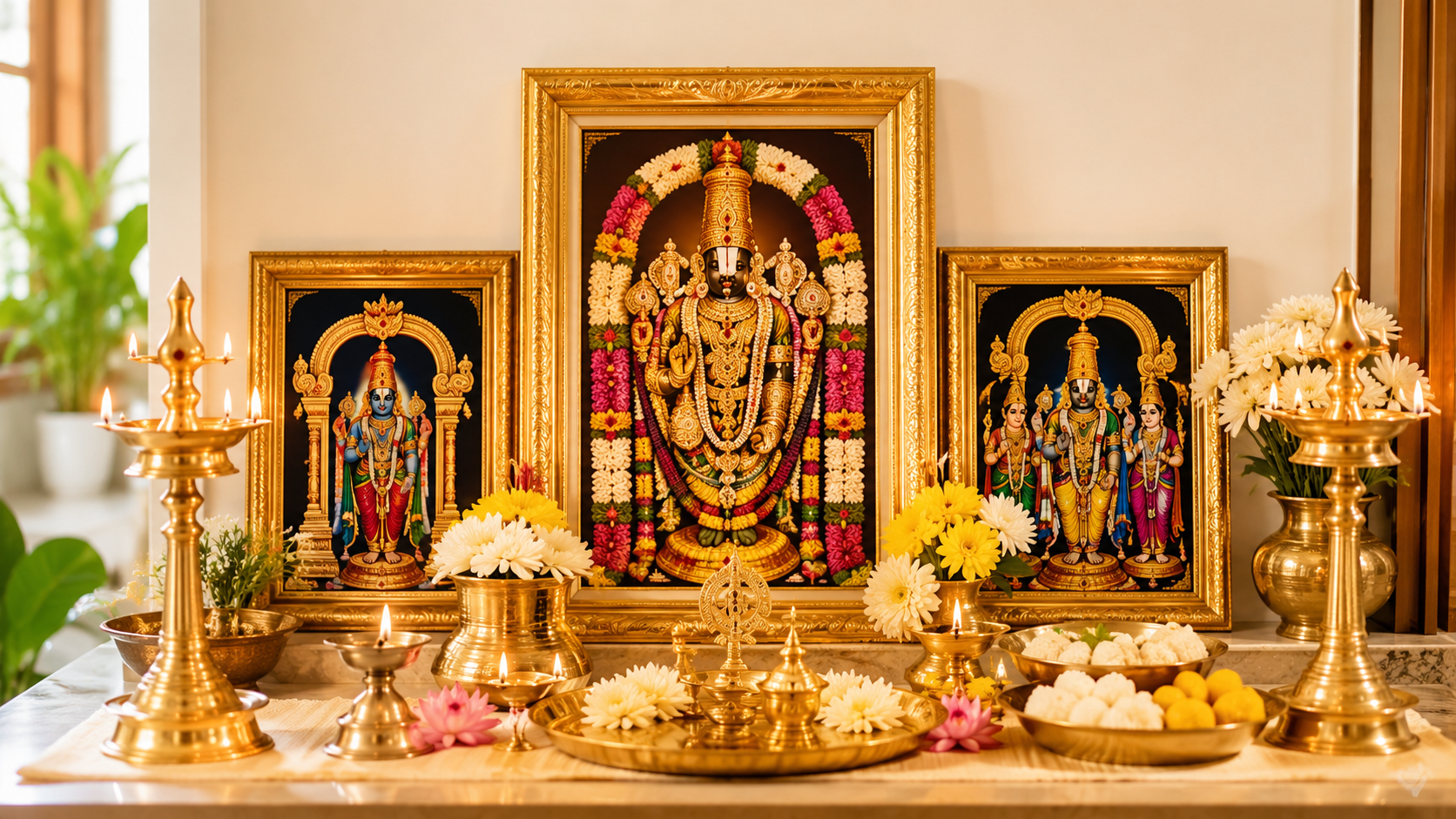
What Is a Thirunakshatram in Sri Vaishnava Tradition?
A Thirunakshatram is one of the most beautiful ideas in Sri Vaishnava tradition.
At a simple level, it means a sacred birth-star observance. “Thiru” indicates sacredness, auspiciousness, and reverence. “Nakshatram” means star. Together, Thirunakshatram refers to the holy nakshatra day associated with the appearance, birth, or sacred remembrance of a revered personality in the Sri Vaishnava sampradayam.
But that definition alone is too small.
In Sri Vaishnava life, a Thirunakshatram is not merely a “birthday.” It is a day of anusandhanam — conscious remembrance. It is a day to remember the grace of Perumal and Thayar, the devotional outpouring of the Azhwars, the protective guidance of the Acharyas, and the guru parampara that carried the sampradayam across generations.
A Thirunakshatram is a bridge between:
Temple and home
Past and present
Devotion and family life
Azhwar pasurams and daily practice
Acharya teachings and lived values
Children and grandparents
India and the global Sri Vaishnava diaspora
For families in India, the United States, Canada, the United Kingdom, Australia, Singapore, the Middle East, and beyond, Thirunakshatrams are powerful cultural anchors. They help children understand that Sri Vaishnavism is not only a philosophy. It is a living family tradition.
The Deeper Meaning: Thirunakshatram as Sacred Remembrance
A modern birthday usually celebrates the individual. A Thirunakshatram celebrates the divine purpose revealed through that individual.
When families observe Andal Thirunakshatram, they are not only remembering Andal’s appearance on Aadi Pooram. They are remembering Thiruppavai, Nachiyar Thirumozhi, devotion to Kannan, and the way Andal continues to shape Margazhi and Sri Vaishnava family life.
When families observe Nammalwar Thirunakshatram on Vaikasi Visakam, they are not only remembering the birth star of Nammalwar. They are remembering Thiruvaymozhi, the depth of surrender, and the heart of Divya Prabandham.
When families observe Sri Ramanuja Thirunakshatram on Chithirai Thiruvadhirai, they are not only remembering a great historical Acharya. They are remembering the protection of Vishishtadvaita, the organization of sampradayam, temple service, compassion, and the path of prapatti.
When families remember Periya Piratti on Panguni Uthiram, they remember Sri Mahalakshmi’s purushakaram — her compassionate mediating role — and the inseparable grace of the Divya Dampati.
A Thirunakshatram therefore asks one central question:
What gift did this sacred personality give to the sampradayam, and how can our family remember and live that gift today?

Thirunakshatram, Jayanthi, Avatara Dinam, and Utsavam: Important Differences
1. Thirunakshatram
A sacred birth-star observance tied to a Tamil month and nakshatra. This is especially common for Azhwars, Acharyas, Perumal, Thayar, and certain revered personalities.
Examples:
Andal — Aadi Pooram
Nammalwar — Vaikasi Visakam
Sri Ramanuja — Chithirai Thiruvadhirai
Vedanta Desika — Purattasi Thiruvonam
Manavala Mamunigal — Aippasi Thirumoolam
Periya Piratti — Panguni Uthiram
2. Avatara Dinam or Jayanthi
An appearance day of Bhagavan’s avataras, often based on tithi, nakshatra, or both.
Examples:
Sri Rama Navami
Sri Jayanthi / Krishna Jayanthi
Narasimha Jayanthi
Hayagriva Jayanthi
Vamana Jayanthi
These are deeply important Vaishnava observances, but they may not always be framed as “Thirunakshatram” in the same sense as Azhwar and Acharya birth-star days.
3. Utsavam
A temple festival or ceremonial observance. Utsavams may run for one day, several days, or even longer.
Examples:
Brahmotsavam
Garuda Sevai
Pavithrotsavam
Adhyayana Utsavam
Pagal Pathu and Ira Pathu
Teppotsavam
4. Vratham / Ekadashi / Festival Observance
Some sacred days are tied to fasting, tithi, or broader Hindu calendar practice.
Examples:
Vaikunta Ekadashi
Ekadashi observances
Deepavali
Karthigai Deepam
Purattasi Saturdays
This distinction matters because it keeps the article theologically clean and avoids forcing every festival into one category.
How Thirunakshatram Dates Are Calculated
Thirunakshatrams are usually expressed using:
Tamil month
Nakshatra
Sometimes tithi or additional calendar context
Local panchangam
Temple or acharya tradition
The Gregorian date changes each year. For example:
Andal Thirunakshatram is observed on Aadi Pooram.
Nammalwar Thirunakshatram is observed on Vaikasi Visakam.
Sri Ramanuja Thirunakshatram is observed on Chithirai Thiruvadhirai.
Vedanta Desika Thirunakshatram is observed on Purattasi Thiruvonam.
Manavala Mamunigal Thirunakshatram is observed on Aippasi Thirumoolam.
Families should check their local temple calendar, panchangam, or acharya tradition for exact annual dates.
This is especially important for families outside India because time zones and temple scheduling may affect local observance.
What Is a Taniyan?
A taniyan is an invocatory verse of praise. It is usually recited before studying, reciting, or remembering a particular Azhwar, Acharya, prabandham, grantham, or revered personality.
In simple terms, a taniyan does three things:
It identifies the greatness of the person being remembered.
It places the devotee in a posture of humility and gratitude.
It prepares the mind for recitation, learning, or anusandhanam.
A taniyan is not casual praise. It is devotional framing. It tells the heart:
Before I approach this pasuram, teaching, or sacred personality, let me first remember the one through whom this grace came to us.
In many temples, homes, mutts, and goshtis, taniyans are part of the order of recitation. Different sampradayams, mutts, temples, and families may recite different taniyans or use different recitation sequences.
Therefore, the table below should be treated as a reference guide, not a replacement for family, temple, or acharya instruction.
Important Editorial Note About Taniyans
There is no single universal “one table” that every Sri Vaishnava family will follow exactly.
Taniyans may vary based on:
Thenkalai or Vadakalai tradition
Mutt or acharya sambandham
Temple practice
Family tradition
Whether the context is daily anusandhanam, prabandham recitation, grantha kalakshepam, festival observance, or temple utsavam
Some personalities have multiple taniyans. Some observances, especially avatara jayanthis, are more commonly associated with stotras, pasurams, or festival recitations rather than one standard taniyan.
Perumal, Thayar, and Foundational Sri Vaishnava Taniyans
1. Periya Perumal / Sri Ranganatha / Sriman Narayana
Common association: Periya Perumal / Sri Ranganatha / Sriman Narayana
Observance note: Calendars and recitation traditions may list Periya Perumal / Sriman Narayana under different contexts. Follow local temple and acharya tradition.
Taniyan:
srI sthanAbharaNam thEja: srIrangEsayam AsrayE
chinthAmaNi mivOthvAntham uthsangE ananthabhOgina:
Simple meaning:
I seek refuge in Sri Ranganatha, who shines as a radiant ornament to Sri Mahalakshmi and reclines on Adisesha in Srirangam like a precious gem.
2. Periya Piratti / Sri Mahalakshmi / Sri Ranganayaki
Common association: Panguni Uthiram
Taniyan:
nama: sriranga nAyakyai yath bhrO vibhrama bhEdhatha:
IsEsithavya vaishamya nimnOnnatham idham jagath
Simple meaning:
I bow to Sri Ranganayaki, whose compassionate will determines the fortunes and conditions of all beings.
3. Vishwaksenar / Senai Mudaliyar
Common association: Aippasi Pooradam
Taniyan:
srIrangachandhramasam indhirayA viharthum
vinyasya visvachidha chinnayanAdhikAram
yO nirvahathya nisamanguLi mudhrayaiva
sEnAnyam anya vimukAs thamasi sriyAma
Simple meaning:
We take refuge in Vishwaksenar, the divine commander who administers the universe by the authority given by Perumal.

Azhwar Thirunakshatrams and Taniyans
1. Poigai Azhwar
Thirunakshatram: Aippasi Thiruvonam
Prabandham: Mudhal Thiruvandhadhi
Taniyan:
kAnchyAm sarasi hEmAbjE jAtham kAsAra yOginam
kalayE ya: sriya:pathyE ravim dhIpam akalpayath
Simple meaning:
I meditate on Poigai Azhwar, born in a golden lotus in Kanchipuram, who lit the lamp of vision for Sriman Narayana.
2. Bhoothathazhwar
Thirunakshatram: Aippasi Avittam
Prabandham: Irandam Thiruvandhadhi
Taniyan:
mallApura varAdhIsam mAdhavI kusumOdhbhavam
bhUtham namAmi yO vishNOr gYAnadhIpam akalpayath
Simple meaning:
I worship Bhoothathazhwar, born from the Madhavi flower in Thirukkadalmallai, who lit the lamp of knowledge for Vishnu.
3. Peyazhwar
Thirunakshatram: Aippasi Sathayam
Prabandham: Moonram Thiruvandhadhi
Taniyan:
dhrushtvA hrushtam thadhA vishNum ramayA mayilAdhipam
kUpE rakthOthpalE jAtham mahathAhvayam AsrayE
Simple meaning:
I take refuge in Peyazhwar, born in a red lily in Mylapore, who rejoiced upon seeing Vishnu with Sri Mahalakshmi.
4. Thirumazhisai Azhwar
Thirunakshatram: Thai Magham
Prabandhams: Thiruchanda Virutham, Nanmugan Thiruvandhadhi
Taniyan:
Sakthi panchamaya vigrahAthmanE sUkthikArajatha chiththa hAriNE
mukthidhAyaka murAri pAdhayOr bhakthisAra munayE namO nama:
Simple meaning:
Repeated salutations to Bhaktisara Muni, Thirumazhisai Azhwar, whose heart is absorbed in the lotus feet of Murari and whose devotion leads toward liberation.
5. Madhurakavi Azhwar
Thirunakshatram: Chithirai Chithirai
Prabandham: Kanninun Siruthambu
Taniyan:
avidhitha vishayAntharas chatArEr upanishadhAm upagAna mAthra bOga:
api cha guNa vachAth thadhEka sEshi madhurakavir hrudhayE mamAvirasthu
Simple meaning:
May Madhurakavi Azhwar live in my heart — he knew no refuge other than Nammalwar and found joy only in singing of him.
6. Nammalwar
Thirunakshatram: Vaikasi Visakam
Prabandhams: Thiruvaymozhi, Thiruvirutham, Thiruvasiriyam, Periya Thiruvandhadhi
Taniyan:
mAthA pithA yuvadhayas thanayA vibhUthi:
sarvam ya dhEva niyamEna madh anvayAnAm
Adhyasyana: kulapathEr vakuLAbhirAmam
srImath thadhangri yugaLam praNamAmi mUrdhnA
Simple meaning:
I bow to the lotus feet of Nammalwar, the leader of our lineage, who becomes mother, father, family, wealth, and everything for those in our spiritual line.
7. Kulashekhara Azhwar
Thirunakshatram: Masi Punarpusam
Prabandham: Perumal Thirumozhi
Taniyan:
gushyathE yasya nagarE rangayAthrA dhinE dhinE
tham aham sirasA vandhE rAjAnam kulasEkaram
Simple meaning:
I bow to King Kulashekhara, in whose city the journey to Srirangam is praised every day.
8. Periyazhwar
Thirunakshatram: Ani Swathi
Prabandham: Periyazhwar Thirumozhi
Taniyan:
gurumukam anadhIthya prAha vEdhAn asEshAn
narapathi parikluptham sulkamAdhAthu kAma:
svasuram amara vandhyam ranganAthasya sAkshAth
dhvija kula thilakam tham vishNuchiththam namAmi
Simple meaning:
I worship Vishnuchitta, Periyazhwar, the jewel among Brahmanas and the father-in-law of Sri Ranganatha through Andal.
9. Andal / Goda Devi
Thirunakshatram: Aadi Pooram
Prabandhams: Thiruppavai, Nachiyar Thirumozhi
Taniyan:
nILA thunga sthanagiri thatI suptham udhbOdhya krishNam
pArArthyam svam sruthi satha siras sidhdham adhyApayanthI
svOchishtAyAm srajinigaLitham yAbalAth kruthya bhungthE
gOdhA thasyai nama idham idham bhUya EvAsthu bhUya:
Simple meaning:
Again and again, I bow to Goda Devi, who awakened Krishna, taught the truth of dependence on Bhagavan, and offered garlands first worn by herself.
10. Thondaradippodi Azhwar
Thirunakshatram: Margazhi Kettai
Prabandhams: Thirumalai, Thiruppalliyezhuchi
Taniyan:
thamEva mathvA paravAsudhEvam rangEsayam rAjavadharhaNiyam
prAbhOdhikIm yOkrutha sUkthimAlAm bhakthAngrirENum bhagavanthamIdE
Simple meaning:
I praise Thondaradippodi Azhwar, who composed Thiruppalliyezhuchi to awaken Sri Ranganatha, seeing him as Para Vasudeva himself.
11. Thiruppaan Azhwar
Thirunakshatram: Karthigai Rohini
Prabandham: Amalanadipiran
Taniyan:
ApAdha chUdam anubhUya harim SayAnam
madhyE kavErathu hithur mudhithAntharAthmA
adhrashtruthAm nayanayOr vishayAntharANAm
yO nischikAya manavai munivAhananam tham
Simple meaning:
We meditate on Thiruppaan Azhwar, Munivahana, who experienced Sri Ranganatha from divine feet to crown and resolved that his eyes would see nothing else.
12. Thirumangai Azhwar
Thirunakshatram: Karthigai Karthigai
Prabandhams: Periya Thirumozhi and others
Taniyan:
kalayAmi kalidhvamsam kavim lOka dhivAkAram
yasya gObi: prakAsAbir Avidhyam nihatham thama:
Simple meaning:
I meditate on Thirumangai Azhwar, the radiant poet whose words remove the darkness of ignorance.
Core Acharya Thirunakshatrams and Taniyans
1. Nathamunigal
Thirunakshatram: Ani Anusham
Taniyan:
nama: achinthya adhbutha aklishta jnAna vairAgya rAsayE
nAthAya munayE agAdha bhagavadh bhakthi sindhavE
Simple meaning:
I bow to Nathamunigal, an ocean of knowledge, detachment, and deep devotion to Bhagavan.
2. Alavandar / Yamunacharya
Thirunakshatram: Aadi Uthradam
Taniyan:
yath padhAmbhOruhadhyAna vidhvasthAsEsha kalmasha:
vasthuthAmupayA thOham yAmunEyam namAmitham
Simple meaning:
I bow to Yamunacharya, by meditating on whose lotus feet one’s defects are removed and true spiritual identity is awakened.
3. Periya Nambi / Mahapurna
Thirunakshatram: Margazhi Kettai
Taniyan:
kamalApathi kalyANa guNAmrutha nishEvayA
pUrNa kAmAya sathatham pUrNAya mahathE nama:
Simple meaning:
I bow to Mahapurna, who is fulfilled by constantly enjoying the auspicious qualities of Kamalapathi, Sriman Narayana.
4. Sri Ramanuja / Emperumanar
Thirunakshatram: Chithirai Thiruvadhirai
Taniyan:
yOnithyam achyutha padhAmbuja yugma rukma
vyAmOhathas thathitharANi thruNAya mEnE
asmadhgurOr bhagavathOsya dhayaikasindhO:
rAmAnujasya charaNau sharaNam prapadhyE
Simple meaning:
I surrender to the feet of Sri Ramanuja, the ocean of compassion, who was so attached to Achyuta’s lotus feet that everything else seemed like grass.
5. Embar
Thirunakshatram: Thai Punarpusam
Taniyan:
rAmAnuja padha chAyA gOvindhAhva anapAyinI
thadhA yaththa svarUpA sA jIyAn madh visramasthalee
Simple meaning:
May Embar, Govinda Bhattar, who is inseparable from Sri Ramanuja like the shade of his feet, be victorious as my place of rest.
6. Parasara Bhattar
Thirunakshatram: Vaikasi Anusham
Taniyan:
srI parAsara bhattArya srIrangEsa purOhitha:
srIvathsAnga sutha: srImAn shrEyasE mEsthu bhUyasE
Simple meaning:
May Parasara Bhattar, the son of Koorathazhwan and priest of Sri Ranganatha, bless me with auspiciousness.
7. Nanjeeyar
Thirunakshatram: Panguni Uthiram
Taniyan:
namO vEdhAntha vEdhyAya jagan mangaLa hEthavE
yasya vAgamruthasAra pUritham bhuvana thrayam
Simple meaning:
I bow to Nanjeeyar, whose nectar-like words fill the three worlds with auspiciousness.
8. Nampillai
Thirunakshatram: Karthigai Karthigai
Taniyan:
vEdhAntha vEdhya amrutha vArirAsEr
vEdhArtha sAra amrutha pUramagryam
AdhAya varshantham aham prapadhyE
kAruNya pUrNam kalivairidhAsam
Simple meaning:
I surrender to Nampillai, full of compassion, who pours forth the essence of Vedanta like nectar.
9. Pillai Lokacharya
Thirunakshatram: Aippasi Thiruvonam
Taniyan:
lOkAchAryAya guravE krishNa pAdhasya sUnavE
samsAra bhOgi sandhashta jIva jIvAthavE nama:
Simple meaning:
I bow to Pillai Lokacharya, the great teacher and son of Krishna Pada, who is like medicine for souls bitten by the serpent of samsara.
10. Thiruvaymozhi Pillai
Thirunakshatram: Vaikasi Visakam
Taniyan:
nama: srIsailanAthAya kunthI nagara janmanE
prasAdhalabdha parama prApya kainkaryasAlinE
Simple meaning:
I bow to Thiruvaymozhi Pillai, SrIsailanatha, who received the blessing of supreme kainkaryam.
11. Manavala Mamunigal
Thirunakshatram: Aippasi Thirumoolam
Taniyan:
srIsailEsa dhayA pAthram dhIbhakthyAdhi guNArNavam
yathIndhra pravaNam vandhE ramya jAmAtharam munim
Simple meaning:
I bow to Manavala Mamunigal, recipient of Thiruvaymozhi Pillai’s mercy, an ocean of knowledge and devotion, deeply attached to Sri Ramanuja.
12. Koorathazhwan
Thirunakshatram: Thai Hastham
Taniyan:
srIvathsa chinna misrEbyO nama ukthima dhImahE:
yadhukthayas thrayi gaNtE yaanthi mangaLa sUthradhAm:
Simple meaning:
We offer obeisance to Srivatsanka Misra, Koorathazhwan, whose words serve as auspicious adornment for the Vedas.
13. Mudaliandan
Thirunakshatram: Chithirai Punarpusam
Taniyan:
pAdhukE yathirAjasya kathayaNthi yadhAkyayA
thasya dhAsarathE: pAdhau chirasA dhArayAmyaham
Simple meaning:
I carry on my head the feet of Dasarathi, Mudaliandan, whose name is associated with the sandals of Yathiraja.
14. Thirukkachi Nambi
Thirunakshatram: Masi Mrigashirsham
Taniyan:
dhEvarAja dhayApAthram srI kAnchi pUrNam uththamam
rAmAnuja munEr mAnyam vandhEham sajjanAsrayam
Simple meaning:
I worship Thirukkachi Nambi, the recipient of Lord Varadaraja’s grace and one respected by Sri Ramanuja.
15. Thirukkurugaippiran Pillan
Thirunakshatram: Aippasi Pooradam
Taniyan:
dhrAvidAgama sAragyam rAmAnuja padhAsritham
sudhiyam kurukEsAryam namAmi sirasAnhavam
Simple meaning:
I bow to Kurukesarya, who knew the essence of the Dravida Veda and took refuge in Sri Ramanuja’s feet.
16. Periyavachan Pillai
Thirunakshatram: Avani Rohini
Taniyan:
srImath krishNa samAhvAya namO yAmuna sUnavE
yath katAkshaika lakshyANam sulabha: srIdharas sadhA
Simple meaning:
I bow to Periyavachan Pillai, Sri Krishna, by whose merciful glance Sridhara becomes easily approachable.
17. Vedanta Desika
Thirunakshatram: Purattasi Thiruvonam
Taniyan:
srImAn vEnkatanAthArya: kavithArkkika kEsarI
vEdhAnthAchAryavaryO mE sannidhaththAm sadhA hrudhi
Simple meaning:
May Vedanta Desika, Venkatanatha, the lion among poets and logicians, always dwell in my heart.
Sri Rama Navami, Sri Jayanthi, Narasimha Jayanthi, and Hayagriva Jayanthi
These are central Vaishnava observances, but they should be handled slightly differently.
For avatara days, families often recite:
Relevant Divya Prabandham pasurams
Stotras connected to the avatara
Nama sankirtanam
Temple-specific recitations
Family or acharya-parampara practices
Examples:
Sri Rama Navami may include Rama-related pasurams, Ramayana readings, or Rama stotras.
Sri Jayanthi may include Krishna-related pasurams, Thiruppavai, or Kannan-focused anubhavam.
Narasimha Jayanthi may include Narasimha stotras and Prahlada-related reflections.
Hayagriva Jayanthi may include Hayagriva Stotram, especially in some traditions.
For SVMatrimony’s editorial system, these should be treated as Avatara / Jayanthi articles, not forced into the same taniyan structure as Azhwar and Acharya Thirunakshatrams.
How Temples Observe Thirunakshatrams
Temple observance varies by location, sampradayam, and temple tradition. Still, many Thirunakshatram observances may include:
Special alankaram
Thirumanjanam or abhishekam where appropriate
Recitation of taniyans
Divya Prabandham sevakalam
Satrumurai
Vazhi thirunamam
Upanyasam or short discourse
Purappadu or procession where practiced
Prasadam distribution
Community participation and kainkaryam
In a temple setting, the Thirunakshatram is not just a ritual. It becomes a community classroom. Children see elders recite. Families hear stories. The Azhwar or Acharya becomes real, not merely a name in a book.
How Families Can Observe Thirunakshatrams at Home
Not every family can attend a temple for every observance. Many families live far from Sri Vaishnava temples. Some are still learning. Some have children, school, work, or travel constraints.
A home observance can still be meaningful.
Simple Home Observance Framework
Light a lamp.
Mention the day: “Today is Andal Thirunakshatram,” or “Today we remember Sri Ramanuja.”
Recite or listen to the taniyan.
Read one short story or lesson.
Recite or listen to one pasuram, stotram, or discourse.
Offer simple prasadam.
Call elders or grandparents and ask them to explain the significance.
Teach children one sentence about the Azhwar, Acharya, Perumal, or Thayar.
This is enough to create continuity.
A family that teaches a child one taniyan, one pasuram, or one story each year is preserving something deeply valuable.

Why Thirunakshatrams Matter for Children and Younger Generations
Children often connect with tradition through stories before they connect with philosophy.
A Thirunakshatram gives parents a simple opportunity:
Tell the story of Andal’s devotion.
Explain Nammalwar’s Thiruvaymozhi.
Share why Sri Ramanuja is called Emperumanar.
Explain the compassion of Periya Piratti.
Describe the discipline and wisdom of Vedanta Desika.
Talk about Manavala Mamunigal’s devotion to Acharya parampara.
These moments make tradition personal.
Children may not remember every Tamil month immediately. But they may remember:
The lamp lit at home
The prasadam made that day
The story told by a grandparent
The sound of a taniyan
The feeling of belonging to a sampradayam
That is how culture survives.
Thirunakshatram and Matrimony: Why This Belongs on SVMatrimony
At first glance, Thirunakshatram content may seem separate from matrimony. It is not.
For Sri Vaishnava families, marriage is not only about education, job, city, and family background. It is also about the kind of home two people hope to build.
A home shaped by Sri Vaishnava values may include:
Respect for elders
Temple involvement
Festival observance
Teaching children tradition
Shared respect for Perumal and Thayar
Appreciation for Azhwars and Acharyas
Recitation, prasadam, and family prayer
Humility, service, and gratitude
When families evaluate compatibility, they are often asking:
Will this person and family help preserve the values we care about?
Thirunakshatram observances reveal those values in action.
A couple does not need to practice every detail in the same way. But shared respect for tradition can become a meaningful foundation for married life.
Preserve Tradition. Build Family Life With Shared Values.
Thirunakshatrams remind Sri Vaishnava families that devotion is carried through remembrance, recitation, teaching, and lived family practice.
For global families, these observances help children stay connected to Perumal, Thayar, Azhwars, Acharyas, Divya Prabandham, temples, and the guru parampara.
At SVMatrimony, we believe meaningful matrimony is rooted in more than profiles. It is rooted in family values, cultural continuity, and shared respect for tradition.
Whether your family lives in India, the United States, Canada, the United Kingdom, Australia, or elsewhere, SVMatrimony helps Sri Vaishnava families connect with trust, dignity, and shared purpose.
FAQ Section
What is a Thirunakshatram?
A Thirunakshatram is a sacred birth-star observance in the traditional Hindu calendar. In Sri Vaishnava tradition, it often refers to the annual observance of the birth star or sacred appearance day of Perumal, Thayar, an Azhwar, an Acharya, or another revered personality.
Is Thirunakshatram the same as a birthday?
It is similar to a birthday, but it has a deeper devotional meaning. A Thirunakshatram remembers the grace, teachings, devotion, and spiritual contribution connected to that sacred personality.
What is a taniyan?
A taniyan is an invocatory verse of praise. It is often recited before remembering an Azhwar, Acharya, prabandham, grantham, or sacred personality. It prepares the mind with humility and gratitude.
Do all Thirunakshatrams have a taniyan?
Many Azhwar and Acharya Thirunakshatrams have commonly recited taniyans. Some divine observances and avatara days are instead associated with stotras, pasurams, or temple-specific recitations. Practice varies by tradition.
Why do Thirunakshatram dates change each year?
Thirunakshatrams are usually based on Tamil month and nakshatra, not a fixed Gregorian calendar date. Therefore, the Gregorian date changes each year.
How should families know the correct date?
Families should check their local temple calendar, panchangam, acharya tradition, or mutt calendar, especially if they live outside India.
Can families observe Thirunakshatram at home?
Yes. Families can light a lamp, recite or listen to the taniyan, read a short story, offer flowers, prepare simple prasadam, and teach children one lesson from the Azhwar, Acharya, Perumal, or Thayar being remembered.
Why does Thirunakshatram matter for matrimony?
For Sri Vaishnava families, marriage is connected to family values, cultural continuity, temple life, and spiritual grounding. Thirunakshatram observance reflects the kind of tradition-centered home a couple may build together.